Stop scrolling for a second. We need to talk about the end. The big fade to black. Death.
For practically all of human history, death was the period at the end of the sentence. It was absolute. Final. Game over. You die, you rot, or you burn. That was the deal. But what if I told you that the rules of the game just changed? What if death isn’t a wall, but a waiting room?
Something happened in a lab that the mainstream media barely glanced at, but it fundamentally shifts our understanding of existence.

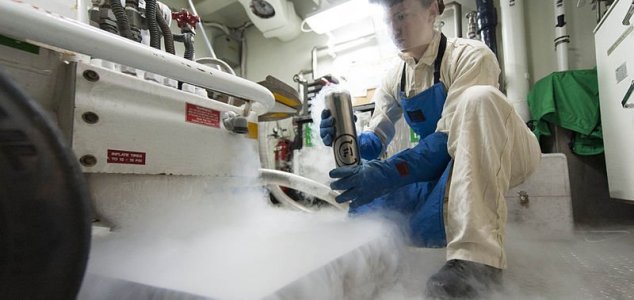
Look at that image. It looks cold, doesn’t it? That represents the frontier between you and eternity.
Scientists have been chasing the dream of stopping the clock for decades. You’ve seen it in movies. Austin Powers. Vanilla Sky. The idea that you can freeze a body and wake it up when they have a cure for whatever killed you. It sounds great on paper.
But there was always a massive, messy problem.
Biology doesn’t like to be frozen.
When you freeze a human body—or specifically, a human brain—the water inside your cells turns into ice. Think about a soda can you left in the freezer too long. It expands. It bursts. Ice crystals are jagged, sharp, and destructive. In the past, “cryonics” was basically turning your brain into hamburger meat. Sure, the chemical makeup was there, but the structure? The wiring? Shredded.
Until now.
The Rabbit That Cheated Death
This is where things get wild. Researchers achieved a world first. They didn’t just freeze a mammal brain; they successfully thawed a cryonically frozen rabbit brain.
But “thawed” is a boring word. It doesn’t capture the magic here.
They restored it to “near-perfect” condition. We are talking about the physical structure of the brain remaining completely intact. No ice damage. No shredded cells. It looked exactly the same coming out of the deep freeze as it did going in.
How? Why is this suddenly possible?
The breakthrough came from a technique called Aldehyde-stabilized cryopreservation (ASC). It sounds like a mouthful, but the concept is brilliant. Instead of just freezing the water, they used a specific chemical fixation process. They pump the brain full of a chemical called glutaraldehyde.
Think of it like this: Imagine a spiderweb made of wet silk. If you freeze it, the water expands and snaps the silk. But if you dipped that spiderweb in liquid glass first, freezing it solid? The shape stays perfect. That is essentially what they did to the rabbit’s brain.
They turned the biology into a solid, glass-like state. This process is called vitrification.
The Connectome: Where Your Soul Lives
Why does the structure matter so much? Why do we care if the cells are intact?
Because of you.
Most neuroscientists agree on one thing: You are your connectome. You are not the meat in your head. You are the electrical patterns and the physical connections—the synapses—between your neurons. Your memories, your personality, your love for pizza, your fear of spiders—it’s all encoded in the physical wiring of your brain.
Up until now, attempting to freeze a brain resulted in significant damage to these neural connections. The “map” of you was erased. Trying to revive a brain with shredded synapses is like trying to play a vinyl record that has been sanded smooth. The music is gone.
But this new technique changed the math.
Dr. Kenneth Hayworth is the president of the Brain Preservation Foundation. Five years ago, his foundation threw down a gauntlet. They challenged the scientific community: Find a way to preserve the map.
When he saw the results of the rabbit experiment, he didn’t mince words.
“Every neuron and synapse looks beautifully preserved across the entire brain,” Hayworth said.
Let that sink in. Every. Single. Neuron.
“It’s the first time that we have a procedure that can protect everything neuroscientists think is involved with learning and memory. Given the results announced today, it seems to me that long-term memories are successfully preserved by this technique.”
The “Upload” Theory: A New Path to Immortality
Here is where we have to go off the deep end. We need to look at what this actually means for the future of humanity.
When people think of cryonics, they think of Walt Disney thawing out and walking around Disneyland again in his own body. That is old-school thinking. That is analog thinking in a digital world.
The ASC technique involves fixing the brain with chemicals that might actually make the biological tissue toxic or biologically “dead” in the traditional sense. You might not be able to just warm up that rabbit brain and have it start hopping around immediately.
So, what is the point?
Digitization.
If the structure is perfectly preserved—if the “glass” brain is a perfect snapshot of the synapses—we don’t need to revive the meat. We need to scan it.
Future technology could slice this preserved brain into nano-thin layers, scan them with electron microscopes, and build a 3D digital model of the brain. If the map is perfect, and we simulate the electricity…
You wake up.
Not in a body. In a server.
This is the gateway to Mind Uploading. This is the bridge between biology and the machine. The rabbit prove that we can save the data file. We just need to build the computer powerful enough to run the software.
The Next Phase: From Rabbits to Pigs to… You?
The team isn’t stopping with Bugs Bunny. The science moves fast. The next step for the team will be to preserve a larger mammal’s brain—most likely that of a pig.
Why a pig? Because a pig’s brain is remarkably similar to a human brain in terms of complexity and structure. If they can pull this off with a pig, the door swings wide open for human trials.
Imagine the timeline. In ten years, this could be a service you buy. You go to the hospital when you are terminal. They put you under. They replace your blood with these fixatives. You drift off. They freeze you down to -135 degrees Celsius.
And you wait.
Maybe for a hundred years. Maybe a thousand. You wait until the technology exists to scan you and turn you back on.
The Nightmare Scenario?
We have to ask the hard questions. We can’t just look at the shiny science and ignore the shadows.
If you are uploaded to a computer, is it really you? Or is it just a copy of you that thinks it’s you? The original biology is dead. The “you” that went to sleep is gone. The thing that wakes up has all your memories, tells your jokes, and remembers your childhood. But is it a continuation of your consciousness, or a digital ghost?
And who owns the server?
If you are digital, can you be deleted? Can you be hacked? Can someone edit your memories?
These sound like science fiction plots, but with the success of the Aldehyde-stabilized cryopreservation, they are now valid scientific questions. We are knocking on the door of eternity, and we have no idea who is going to answer.
Robotic Resurrection
Let’s take it a step further. You don’t just want to live in a video game simulation. You want to walk the Earth again.
It is hoped that eventually technologies like this will make it possible to successfully preserve a human brain which can then be revived in the distant future. It may even become possible to integrate a brain with a robot to bring that person back to life.

Picture a chassis made of carbon fiber and synthetic muscle. Sensors that see better than human eyes. A heart that never stops beating because it’s a battery. And inside the control unit? The digital map of your mind, scanned from your preserved brain.
You could be stronger. Faster. Immortal.
The transhumanist movement has been waiting for this “proof of concept” for decades. They call it the Singularity—the moment when human intelligence merges with machine intelligence. This rabbit brain? That is the first brick in the road to the Singularity.
The Cost of Forever
Right now, this is experimental. But soon, it will be an industry. How much would you pay to live forever? Everything you have? The billionaires of Silicon Valley are already pouring money into life extension tech. Peter Thiel, Elon Musk, the Google founders—they are all obsessed with solving the “problem” of death.
This breakthrough gives them a roadmap.
But what happens to a society where the rich never die? Where the brilliant minds (and the ruthless tyrants) can preserve themselves indefinitely, while the rest of us just… fade away?
The thawing of this rabbit brain is a miracle of science. But it’s also a warning shot. The barrier between life and death is getting thinner. The ice is melting.
Are we ready for a world where “Rest in Peace” is just a temporary status update?
The Details Matter
Let’s look at the specifics one more time because they are vital. The technique uses a fixation agent (glutaraldehyde) to cross-link the proteins. This turns the brain into a solid block that doesn’t need water to hold its shape. Then, they use a cryoprotectant (ethylene glycol—yes, basically antifreeze) to prevent ice crystals.
The result is a brain that can sit in liquid nitrogen for centuries without degrading. Not a single synapse snaps. Not a single memory fades. It is paused. Perfection in stasis.
History will look back at this moment. The day the rabbit didn’t die. It might be the most important day in human history since the discovery of fire.
So, I have to ask you: If you had the chance today… if they offered to freeze you down and wake you up in the year 3000 inside a robot body… would you do it?
Or is death a necessary part of being human?
Think about it. Because sooner than you think, you might have to make that choice.
Originally posted 2016-05-04 22:05:39. Republished by Blog Post Promoter