Apollo 11’s Darkest Secret: What Buzz Aldrin REALLY Saw on the Way to the Moon
July 1969. The world held its breath. Three men, strapped into a metal can perched atop a controlled explosion, were hurtling through the black void. Their target? The Moon. Neil Armstrong, Michael Collins, and Buzz Aldrin. Names etched into history, the very symbols of humanity’s reach for the stars.
It was the perfect story. A triumph of science, courage, and the American spirit. But what if the official story, the one we all learned in school, is missing a chapter? What if on their journey through the silent, empty expanse, they discovered they weren’t quite so alone?
For decades, it was just a whisper. A rumor. A conspiracy theory relegated to late-night talk shows and grainy magazines. Then, the dam of secrecy began to crack. And the man holding the hammer was none other than the second human to ever walk on the lunar surface, Buzz Aldrin himself.
In a stunning statement, Aldrin broke a nearly 40-year silence. He admitted, on camera, that the crew of the most famous space mission in history witnessed an Unidentified Flying Object pacing their command module. An object that, to this day, has no official explanation that holds water.
This wasn’t a vague claim. This was a direct admission from a man whose credibility is beyond question. So, what did they see out there in the dark? And why were they forced to keep it a secret for so long?
The Apollo 11 Encounter: A Shot-by-Shot Breakdown
Let’s set the scene. It’s day three of the mission. Earth is a beautiful, shrinking blue marble in their rearview mirror. The Moon is growing ever larger in the window ahead. They are in the vast, empty gulf between worlds. And then, they see it.
Something was moving alongside them. Something that shouldn’t have been there.
In a documentary interview years later, Aldrin laid it all out, choosing his words with the careful precision of a pilot who knows his every move is being watched. “There was something out there, close enough to be observed, and what could it be?” he recalled.
Think about the psychology in that cockpit. You’re further from home than any human has ever been. Your life depends on a million moving parts working perfectly. And now, there’s an unknown. A variable you can’t account for. Aldrin explained the crew’s immediate dilemma:
“Now, obviously the three of us weren’t going to blurt out, ‘Hey, Houston, we’ve got something moving alongside of us and we don’t know what it is, you know?’”
The fear wasn’t just of the unknown object. It was the fear of mission control. The fear of being grounded, of being labeled unstable, of jeopardizing the single most important mission in human history. So they did what any good pilot would do. They observed. They analyzed. They tried to debunk it themselves.
Collins got out the sextant to get a better look, but the object was difficult to focus on. Aldrin described it as L-shaped. They radioed Houston, not with a panic call, but with a carefully worded, technical question. They asked about the location of the S-IVB, the final stage of their Saturn V rocket that had been jettisoned two days earlier.
Houston reported back that the S-IVB was 6,000 nautical miles away. Whatever this thing was, it wasn’t their own discarded booster.
The “Official Story” vs. The Astronauts’ Account
For years, NASA and professional skeptics have clung to a simple explanation. They claim the astronauts were simply seeing one of the four Spacecraft-Lunar Module Adapter (SLA) panels that had been jettisoned to release the Lunar Module, the *Eagle*. These panels, they argue, could have been much closer than the main rocket body.
Makes sense, right? A simple case of mistaken identity?
Wrong.
This explanation falls apart under the slightest scrutiny. Armstrong, Aldrin, and Collins were not just passengers. They were the best of the best. Elite test pilots who knew their vehicle and its components intimately. They had trained for every conceivable contingency, and that included recognizing their own debris. For them to mistake a familiar panel for a mysterious, L-shaped object that they watched for a significant period of time strains all credibility.
More to the point, Aldrin himself has publicly waffled on the explanation, a clear sign of the pressure he was under. In some interviews, he seems to reluctantly accept the panel theory, while in others, like the explosive documentary admission, he clearly states it was an “unidentified” object. He once even said he was “99.9 percent” sure it was an alien craft.
Why the back and forth? Perhaps because telling the full truth is a heavy burden. A truth that NASA has spent half a century trying to bury.

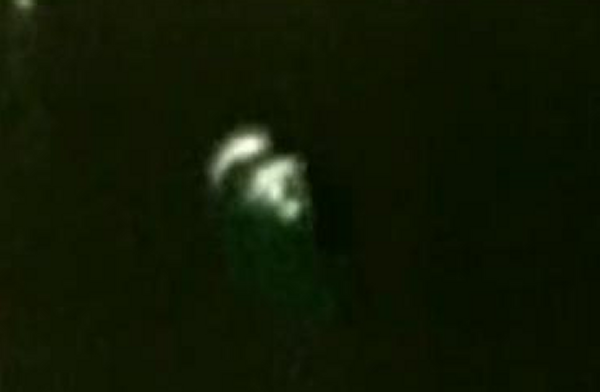
This image, often associated with later missions, is said to be similar to what the Apollo 11 crew witnessed. A craft of unknown origin, silently observing humanity’s first steps into the cosmos. Was it a welcome party? A warning? Or just a curious observer?
The Cover-Up Begins: A Culture of Silence
To understand why the Apollo 11 crew would remain silent, you have to understand the era. This wasn’t just a science mission; it was the final battle of a technological Cold War. The world was watching. The reputation of the United States was on the line. A report of a UFO would have created chaos. It would have shifted the narrative from a story of human achievement to one of cosmic uncertainty. The mission could have been scrubbed. The public might have panicked. The program’s funding would have been in jeopardy.
The “right stuff” ethos of the early astronaut corps demanded unflappable, cool-headed professionalism. Seeing “little green men” was not part of the profile. So an unwritten rule was established: don’t talk about it. Period.
But secrets like this have a way of getting out. Especially when they are kept by multiple people. And Buzz Aldrin wasn’t the only hero astronaut to break ranks.
Enter Gordon Cooper. One of the original Mercury Seven. An American icon. And he was absolutely convinced that UFOs were real, extraterrestrial, and that the government was hiding it.
According to a taped interview, Cooper’s frustration with the secrecy was palpable:
“For many years I have lived with a secret, in a secrecy imposed on all specialists in astronautics. I can now reveal that every day, in the USA, our radar instruments capture objects of form and composition unknown to us. And there are thousands of witness reports and a quantity of documents to prove this, but nobody wants to make them public.”
Cooper didn’t just talk. He testified before the United Nations, pleading for a serious, scientific investigation. He claimed to have personally witnessed a saucer-like craft land at Edwards Air Force Base in the 1950s, a story the military has denied ever since. This wasn’t a man chasing fame. This was a patriot, a hero, trying to tell the world what he knew to be true.
Not Just Apollo: A Pattern of High-Strangeness in Orbit
The Apollo 11 incident wasn’t an isolated event. It was just the most famous. Once you start digging into the mission logs and astronaut interviews from the Mercury, Gemini, and Apollo programs, a shocking pattern emerges. The skies up there were a lot more crowded than we were told.
Gemini’s Phantom Bogey
Years before Apollo 11, in December 1965, another pair of legendary astronauts had their own run-in with the unknown. James Lovell (who would later command the dramatic Apollo 13 mission) and Frank Borman were on their record-breaking 14-day Gemini 7 flight.
During their second orbit, Borman saw something. He reported an unidentified spacecraft some distance from their capsule. Cape Kennedy quickly radioed back, telling him he was probably just seeing the final stage of their Titan booster rocket. A familiar excuse. Borman’s reply was chilling. He confirmed he could see the booster rocket just fine… but he was also seeing something completely different.
The official mission transcript captures another tense exchange from that same mission. The language is pure pilot-speak. It’s not the kind of terminology you use for space junk.
Lovell: BOGEY AT 10 O’CLOCK HIGH.
Capcom: This is Houston. Say again 7.
Lovell: SAID WE HAVE A BOGEY AT 10 O’CLOCK HIGH.
Capcom: Gemini 7, is that the booster or is that an actual sighting?
Lovell: WE HAVE SEVERAL…ACTUAL SIGHTING.
Capcom: …Estimated distance or size?
Lovell: WE ALSO HAVE THE BOOSTER IN SIGHT…
They saw both. Their own rocket booster, and something else. An “actual sighting.” A “bogey”—military slang for an unidentified, potentially hostile craft. What was this bogey doing in Earth’s orbit?
The X-15 Files: NASA’s Secret UFO Hunters?
Even before the race to the Moon, pilots were pushing the very edge of the atmosphere in the rocket-powered X-15. And they were seeing things, too.
On July 17, 1962, Major Robert White, flying his X-15 to an altitude of 58 miles, radioed down about a strange object. “There are things out there!” he exclaimed. “They’re all over the place!”
But the most startling admission came from fellow NASA pilot Joseph Walker. In 1962, Walker stated that one of his express tasks during his X-15 flights was to detect UFOs. Let that sink in. This wasn’t an accidental sighting. Part of his official mission was to hunt for these objects.
He succeeded. Walker confirmed he had filmed five or six UFOs during a flight in April 1962. Where is that film today? Locked away in a vault, most likely. The existence of an official, albeit secret, program to detect UFOs from the edge of space changes everything.
Cernan’s Final Word
Eugene Cernan, commander of Apollo 17 and the last man to leave his footprints on the lunar dust, carried the weight of this secret for years. In a 1973 article in the Los Angeles Times, he was asked about UFOs. His answer was not a denial. It was a profound, philosophical admission from a man who had seen things the rest of us can only dream of.
“…I’ve been asked (about UFOs) and I’ve said publicly I thought they (UFOs) were somebody else, some other civilization.”
Somebody else. Some other civilization. The last man on the Moon believed we are not alone.
The Dark Side of the Moon: More Than Just Footprints?
If astronauts were seeing UFOs on the way to the Moon, what did they see when they actually got there? This is where the story dives deep into the shadows, into rumors of secret radio channels and evidence deliberately scrubbed from the public record.
One of the most persistent stories involves a “two-minute silence” during the Apollo 11 moonwalk. The legend states that Neil Armstrong switched over to a private medical channel to report something unbelievable to a select few back at Mission Control. Amateur radio operators, who claimed to have bypassed NASA’s public broadcast, reported hearing a panicked Armstrong describe what he was seeing.
The alleged transmission? “These babies are huge, sir! Enormous! Oh my God, you wouldn’t believe it! I’m telling you there are other spacecraft out here, lined up on the far side of the crater edge… they’re on the Moon watching us.”
Is it true? NASA, of course, denies it flatly. But the story has refused to die for over 50 years. Why? Because it fits the pattern. A pattern of unbelievable sights followed by official silence.

And then there are the photos. Thousands upon thousands of images from the Apollo missions are publicly available. For decades, researchers have been pouring over them, enlarging them, enhancing them, looking for anomalies. They have found them. Things that look like artificial structures. The “Shard,” a towering spire that appears to rise miles from the lunar surface. The “Tower,” a massive, intricate structure in the Sinus Medii region. Strange lights, geometric shapes, and tracks that seem to start and stop for no reason.
Are they all just tricks of light and shadow, as NASA claims? Or are they weathered ruins of an ancient presence on our celestial neighbor? A presence that NASA discovered, and has been hiding ever since.
The Modern Fallout: From Aldrin’s Confession to Pentagon Videos
For a long time, Aldrin, Cooper, and the other astronauts were lone voices. Credible, but easy to dismiss. But in recent years, the world has started to catch up to what these old space cowboys were saying all along.
In 2017, the New York Times published a bombshell report that confirmed the Pentagon had been secretly running a program to investigate UFOs. Along with the story came three incredible videos, captured by US Navy fighter pilots, showing objects that defied the known laws of physics. The “Tic Tac.” The “Gimbal.” The “GoFast.”
Suddenly, the UFO topic was no longer a joke. It was a matter of national security. The US government has now officially acknowledged that these are Unidentified Aerial Phenomena (UAPs) and that they have no explanation for them.
Aldrin’s confession was not an end point. It was a beginning. It was one of the first major cracks in a dam of secrecy that had stood for 70 years. Now, that dam is crumbling. The testimony of these legendary astronauts is no longer just a wild conspiracy theory. It’s crucial historical context for a reality that is slowly, painstakingly, being revealed to the public.
The evidence is on the table. The witnesses are some of the most respected figures of the 20th century. Men who were chosen for their skill, their stability, and their credibility. They are telling us, in no uncertain terms, that we are not alone, and that they saw the proof with their own eyes.
The only question left is: Why are we still not officially being told the truth?
Originally posted 2016-03-11 04:27:54. Republished by Blog Post Promoter
![alien-on-moon[1]](https://coolinterestingnews.com/wp-content/uploads/2012/07/alien-on-moon1.webp)