Home Unexplained Mysteries Historical Mysteries Mystery of the Mummy Of Sangha Tenzin, Himachal Pradesh, India

Mystery of the Mummy Of Sangha Tenzin, Himachal Pradesh, India

0
71

20140202-124312.webp

The Dead Man Who Refused to Rot

Imagine sitting down. Just sitting. You close your eyes. You slow your breathing. And you decide, right then and there, that you are never standing up again.

Not for water. Not for food. Not to sleep. You are sitting down to die.

Now, imagine staying in that exact position for five hundred years. While empires rise and fall, while wars rage across the planet, while technology jumps from swords to smartphones, you are still there. Sitting. Watching. Waiting.

This isn’t a ghost story. This isn’t a scene from a horror movie. This is the reality of Sangha Tenzin. And he is still looking at us.

Deep in the frozen, oxygen-starved heights of the Indian Himalayas, something impossible was found. It defies biology. It mocks the natural process of decay. Most bodies turn to dust. They bloat, they rot, they feed the worms. But Sangha Tenzin? He fought nature. And he won.

The Earthquake That Cracked the World Open

Let’s rewind to 1975. The Spiti Valley in Himachal Pradesh, India. It looks more like Mars than Earth. It’s a cold desert. High altitude. Brutal winds. A place where silence is so heavy it hurts your ears.

Suddenly, the ground shook. A massive earthquake ripped through the valley. It tore apart roads and shattered silence. But it also did something else. It cracked open history.

When the dust settled in the tiny, remote village of Ghuen (sometimes spelled Gue), the locals saw something strange. An old tomb, hidden for centuries, had split wide open. Inside wasn’t gold. It wasn’t a treasure chest.

It was a man.

But he wasn’t a skeleton. He had skin. He had hair. He was sitting in a meditation pose, knees bent, back straight, staring into the darkness of his stone prison. The villagers were terrified. Was he sleeping? Was he a god? Was he a demon?

For decades, this discovery stayed quiet. Just a local legend whispered in the mountains. The world didn’t know. The internet didn’t exist. It wasn’t until 2004 that the police and excavators finally went in to bring him out into the light. What they found shocked the scientific community to its core.

The Science of “Self-Mummification”: A Slow Suicide?

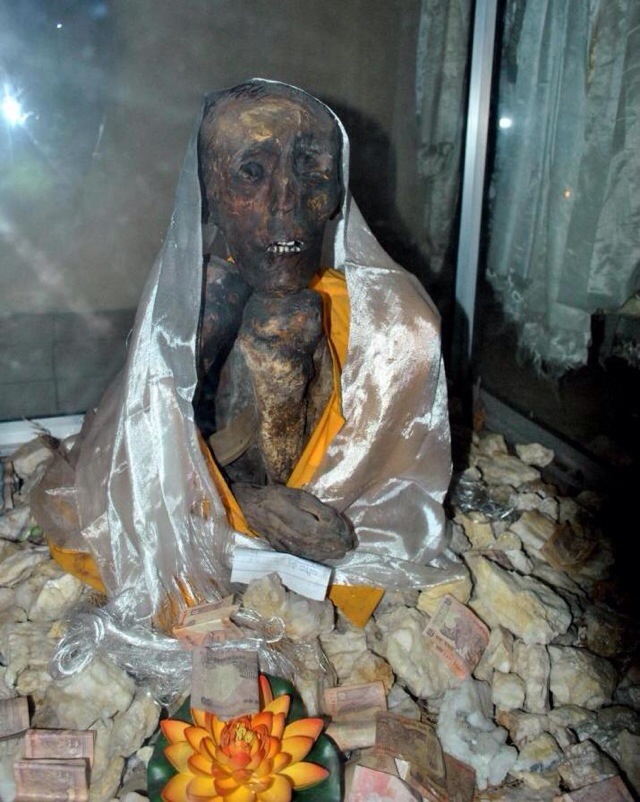
Look at the photo above again. Really look at it. That is not a plastic prop.

That is human skin. Brown, leathery, tight against the skull. You can see his teeth. You can see the individual hairs on his head. How is this possible without heavy chemicals? The Egyptians ripped brains out through noses and stuffed bodies with salts and spices. They spent weeks preparing the dead.

Sangha Tenzin didn’t have a team of embalmers. He did this to himself. While he was still alive.

This brings us to the terrifying, fascinating concept of natural mummification. In Japan, they call it Sokushinbutsu. In Tibet, it’s the highest form of sacrifice. It is a slow, agonizing process that takes years. Experts believe Tenzin started preparing for his death while he was walking, talking, and breathing.

The Starvation Diet

You don’t just sit down and become a mummy. You have to change your chemistry. Theories suggest that monks like Tenzin would stop eating normal food. No rice. No barley. They switched to a diet of tree nuts, roots, and toxic herbs.

Why? To get rid of fat.

Fat contains moisture. Moisture leads to rot. To preserve the body, you must become a living skeleton. They would eat things that made them vomit, purging the water from their systems. They would drink poisonous sap tea to kill the bacteria in their gut. This way, when they finally died, there were no maggots. No bacteria to eat the flesh from the inside out.

They literally turned their bodies into something nothing wanted to eat.

The Mystery of the Rope

Zoom in on the details. When the excavators pulled him from the tomb, they noticed something strange wrapped around his neck and passing under his thighs. A rope. A Gomthag.

This is where it gets dark. And fascinating.

Why the rope? Some skeptics say it was just to hold his posture. When you lose consciousness, when death finally takes you, your head falls forward. Your spine collapses. The rope was a tool to keep him upright in the “Lotus Position.”

But there is another theory. A darker one.

Some historians suggest the rope was the final trigger. As the monk drifted between life and death, weakened by starvation, the rope allowed him to maintain that perfect spiritual alignment. If he relaxed, the rope would tighten. It forced him to stay focused until the very last beat of his heart. It was a tether to his meditation, ensuring he didn’t slouch into the afterlife.

He wasn’t just dying. He was working. Even in his final seconds, he was fighting for perfect form.

Why Would Anyone Do This?

We live in a world of comfort. We like soft beds and warm food. The idea of starving yourself in a freezing stone box sounds like insanity. But you have to understand the context. You have to get into the mind of a 15th-century monk living on the roof of the world.

Local folklore gives us a reason that is far more heroic than simple meditation.

The story goes that 500 years ago, the village of Ghuen was cursed. A plague of scorpions had taken over. Crops were dying. People were getting sick. The village was on the brink of extinction.

Sangha Tenzin didn’t do this for ego. He didn’t do it to be famous on a blog in the 21st century. He did it to pay a karmic debt. The belief was that by sacrificing himself—by undergoing this brutal, slow death—he could absorb the bad luck of the village. He became a spiritual lightning rod.

Legend says that the moment his soul left his body, a rainbow appeared over the village. The scorpions vanished. The plague ended. He traded his life for theirs.

Victor Mair and the Scientific Proof

It’s easy to dismiss village legends. But you can’t dismiss Victor Mair.

Victor Mair is a heavy hitter. A consulting scholar at the University of Pennsylvania Museum of Archaeology and Anthropology. He’s the guy you call when you find something weird in history. When he looked at Sangha Tenzin, he didn’t see a fake.

Mair confirmed the timeline. This body is at least 500 years old. He noted the preservation was “remarkable.” The skin is unbroken. There are no signs of artificial embalming tools. This was pure biology meeting pure willpower, aided by the intense climate.

Spiti is a cold desert. The air is dry. The temperatures drop drastically. It is a natural freezer. Once Tenzin died, the moisture was sucked out of him by the wind and the cold before he could rot. He became a statue of leather and bone.

The “Forbidden” Location: Where is He Now?

You can’t just hop on a bus and see him easily. This adds to the mystery.

The mummy rests in a small, glass case in a temple in Ghuen. This village is about 6,000 meters (nearly 20,000 feet) above sea level. It sits right on the edge of the Indian border with Tibet. This is a militarized zone. The Indo-Tibetan Border Police control the area.

Getting there is an adventure. The roads are treacherous. Landslides are common. The air is thin enough to make you dizzy. It feels like you are entering a restricted zone, a place where regular rules don’t apply.

And there, in a simple room, sits Sangha Tenzin.

He is wearing fresh golden robes now, draped over his withered shoulders. His eyes are hollow, but his face is expressive. His lips are pulled back in what looks like a grimace, or perhaps, intense concentration. He looks like he is about to speak.

Modern Findings: Is He Still “Alive”?

Here is where things get metaphysical. In the Buddhist tradition, high-level monks who achieve this state are not considered “dead” in the Western sense. They are in tukdam—a state of deep, eternal meditation.

Devotees believe he is still conscious. They believe he is still watching over the village. And weirdly enough, the body continues to change slightly over the years, or so the locals claim. Hair continues to appear. The skin color shifts.

Is it biological trickery? Or is it something we just don’t understand yet?

In recent years, other mummies have been found in Mongolia and the Himalayas, sparking a renewed interest in these “Sleeping Monks.” Scientists are using MRI scans to look inside them. They are finding organs still intact. Brain tissue that hasn’t liquefied. It defies every textbook on forensics.

A Warning from the Past

Sangha Tenzin is a time capsule. He represents a level of discipline that the modern world has forgotten. We can barely sit still for five minutes without checking our phones. This man sat still for five centuries.

When you look at the image of him, you are seeing a man who conquered the most primal fear of all: the fear of death. He walked toward it, sat down, and welcomed it.

If you ever make the journey to the Spiti Valley, prepare yourself. It’s a long, bumpy ride. But when you walk into that temple and lock eyes with the man in the glass box, remember one thing.

He was waiting for you.

The temple is open to the public, if you can reach it. The mummy remains remarkably well-preserved, a silent guardian of the Himalayas, holding his breath for eternity.

Originally posted 2014-01-31 12:40:46. Republished by Blog Post Promoter