Home Weird World Space Mars Rover discovers bits of alien metal

Mars Rover discovers bits of alien metal

1
59

Mars is a graveyard. It’s a silent, freezing desert where nothing moves but the wind and the dust. For billions of years, the Red Planet has slept, wrapping its secrets in a thick blanket of oxidized iron. Rust. Everything there is red because everything there is dead and corroded. That is the rule of Mars.

But rules are made to be broken.

On January 30, 2013, the silence was shattered. Not by a sound, but by a glint. The NASA Curiosity Rover, trundling across the Gale Crater, beamed back a set of images that shouldn’t exist. In a world defined by dull, matte red dust, something was shining. Something metallic. Something twisted, smooth, and unmistakably out of place.

Alien Metal on Mars
Alien Metal on Mars

The Anomaly on Sol 173: A Glitch in the Matrix?

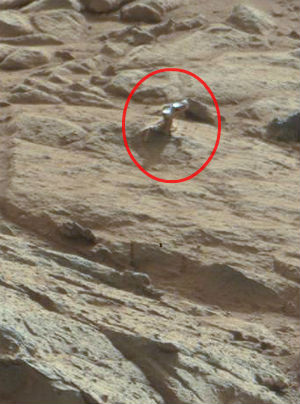
It happened on Sol 173. That’s Martian terminology for the 173rd day of the mission. Curiosity’s Mastcam, the rover’s primary set of eyes, swept across the landscape. Most of the time, these photos are routine. Rock, sand, more rock. But this time, the camera caught a strange “protuberance.”

Look at the image. Really look at it.

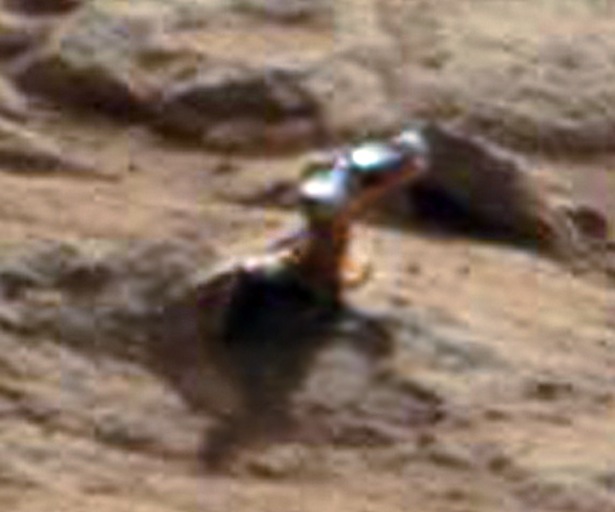
In the middle of a rocky outcrop, jutting out from the bedrock, is a strange chunk of twisted metal. It doesn’t look like a rock. It doesn’t look like the surrounding geology. It catches the sunlight in a way that suggests high reflectivity. It looks polished.

NASA scientists admitted they were baffled. But here is the kicker: they weren’t sure what it was, yet they seemed in no rush to find out. The rover didn’t stop. It didn’t deploy its chemical sniffers. It just kept rolling.

Why? Why would the world’s most advanced mobile laboratory drive right past the most interesting thing seen on the planet in decades?

The Science of Rust: Why Shiny is Impossible

To understand why this photo keeps people awake at night, you have to understand basic chemistry. Mars is red for a reason. The surface is rich in iron. Long ago, when Mars had an atmosphere and water, that iron reacted with oxygen. It rusted. The entire surface of the planet is essentially coated in iron oxide dust.

Oxygen is a brutal element. It eats metal. On Earth, if you leave a wrench in the garden for a year, it turns orange and flaky. On Mars, that process happened on a planetary scale over billions of years.

So, finding exposed, non-corroded metal on the surface is a massive red flag. It’s wrong. It violates the geological timeline.

If this object were native to Mars—a chunk of iron ore jutting out of the ground—it should be covered in the same red dust as everything else. It should be dull. It should be camouflaged.

But it isn’t. It is silver. It is grey. It looks like steel or titanium. This suggests one of two things: either the wind recently scoured it clean (unlikely, given the surrounding dust), or the material is highly resistant to corrosion. Like stainless steel. Or something we don’t even have a name for.

The “Safe” Explanations: Meteorites or Trash?

Whenever something weird pops up on the NASA feed, the “swamp gas” explanations come flying out. The skeptics and the space agency usually offer two potential solutions to calm the public down.

Theory A: The Iron Meteorite

The most widely accepted scientific theory is that this is a fragment of an iron-nickel meteorite. These space rocks are common. They slam into Mars all the time. Because Mars has a thin atmosphere, they don’t burn up as completely as they do on Earth.

Does it hold water? Maybe. Iron meteorites can be shiny. But usually, when they hit the ground, they melt, pit, and deform. They look like blobs. This object has distinct lines. It has a curve. It looks structural. Plus, even a meteorite sitting on Mars for a few hundred years would start to gather dust. This thing looks like it was polished yesterday.

Theory B: We Dropped It

The second theory is that the Curiosity Rover is a litterbug. Critics argue that this could be a piece of debris from the rover’s own landing system. Remember the “Seven Minutes of Terror”? The Sky Crane lowered the rover and then flew away to crash-land at a safe distance.

Could a piece of the Sky Crane have shrapneled off and landed here?

It’s possible. But there’s a problem with the physics. If a piece of metal fell from the sky or was blasted from a crash site, it would be sitting on top of the dirt. Look closely at the photos again. This object isn’t sitting on the dust. It is emerging from the rock.

It looks embedded. Anchored. Like the tip of an iceberg.

Close up it looks like a joystick control

The “Joystick” Theory: Evidence of Manufacturing?

Zoom in. Let’s get really close. The shape of this object is incredibly provocative. It doesn’t look like a random splinter of rock. It has a neck. It has a head. It has a distinct curvature that looks suspiciously ergonomic.

Internet sleuths immediately dubbed it “The Handle” or “The Joystick.” It resembles a mechanical lever you might find in an industrial excavator or an aircraft cockpit.

Elisabetta Bonora, an image processing expert from Alive Universe Images, did a fantastic breakdown of the scale. By counting pixels and analyzing the focal length of the Mastcam, she estimated the visible portion is small—maybe a few centimeters tall. But the way it enters the rock suggests it is merely the protruding end of something much, much larger.

Bonora suggests the object could be up to a foot long, buried deep within the sedimentary rock. If that’s true, the “debris” theory falls apart completely. You can’t have a piece of a 2013 landing craft buried inside rock that is millions of years old.

That leaves us with the uncomfortable option.

If It’s Not Ours, Whose Is It?

This is where we leave the safe harbor of mainstream geology and head out into the deep waters of alternative history. If the object is embedded in ancient rock, and it is made of non-corroding metal, it is an artifact.

Technically, if it’s not from Earth, it is Alien. Period.

But does “Alien” mean little grey men? Not necessarily. It could mean an ancient civilization that existed in our solar system eons before humans banged rocks together. Mars wasn’t always a dead rock. We know it had oceans. We know it had rivers. It had a thick atmosphere.

Is it so crazy to think it might have had industry?

The John Brandenburg Hypothesis: War on Mars

Consider the theories of plasma physicist Dr. John Brandenburg. He has famously argued that the isotopic ratios of Xenon-129 found in the Martian atmosphere are identical to the signatures left behind by nuclear explosions on Earth.

Brandenburg’s theory is terrifying. He suggests Mars wasn’t just inhabited; it was murdered. He believes a massive nuclear event—possibly a war—wiped out life on the Red Planet millions of years ago. The shockwaves stripped the atmosphere and turned the planet into the cold desert we see today.

If he is right, what would be left behind? Not books. Not clothes. Not bodies. Those rot.

Metal. Twisted, melted, blast-hardened metal. Shards of machinery embedded in the bedrock, fused by the heat of a cataclysm. When we look at this “strange chunk of twisted metal,” are we looking at the shrapnel of a planetary war?

NASA’s Strange Silence: The “Nothing to See” Strategy

The most frustrating part of this story isn’t the metal itself. It is the reaction of the space agency. Imagine you are an explorer. You are walking through the Sahara Desert and you see a shiny, silver door handle sticking out of a sandstone cliff. Do you:

A) Take a quick photo and keep walking?

B) Stop everything, dig it up, and change history?

NASA chose option A. They barely acknowledged the find. They stated they were prioritized on drilling into a nearby rock to look for clay deposits. Clay. Mud.

They chose mud over metal.

This behavior feeds into the “Brookings Report” mentality. In the 1960s, a report commissioned by NASA suggested that the discovery of extraterrestrial artifacts could cause the collapse of human society. Religious institutions would crumble. Panic would ensue. The recommendation? If you find evidence, keep it quiet.

Is that what is happening here? Is the silence incompetence, or is it policy?

A Pattern of Anomalies

This metal chunk doesn’t exist in a vacuum. It joins a long list of Martian oddities that get dismissed as “tricks of light and shadow.”

  • The Face on Mars: The famous Viking orbiter image. Dismissed as a hill, but statistically improbable in its symmetry.
  • The Mars Henge: A circular rock formation that looks strikingly like Stonehenge.
  • The “Doorway”: A recent image showing a perfectly cut geometric opening in a rock face.

Each time, the explanation is pareidolia—the human brain’s tendency to see patterns where there are none. But metal is not a pattern. Metal is a material. Reflection is a physical property. You can’t hallucinate a specular highlight on a matte surface.

The Verdict: We Need to Go Back

The Curiosity Rover is still up there, slowly dying as its nuclear battery decays. It has moved miles away from the metal object. We will likely never know exactly what that twisted shard was.

Was it a natural formation of pure iron, polished by sandstorms? Perhaps. Was it a piece of the rover itself, defying the laws of physics to embed itself in rock? Unlikely.

Or was it a piece of a pipe? A lever? A fragment of a hull from a ship that sailed the Martian seas a billion years ago?

The image remains one of the most compelling pieces of evidence for the “Ancient Mars” theory. It sits there, on the hard drive of a server in Pasadena, and in the dusty rock of Gale Crater, waiting for someone brave enough to turn the car around and take a second look.

Until then, it remains a shiny, silver question mark on a rusty, dead world. It is a reminder that we don’t know half as much about our solar system as we think we do.

We are the aliens on Mars. And we might have just stumbled across the wreckage of the people who were there first.

Originally posted 2016-04-25 00:27:57. Republished by Blog Post Promoter