They say the desert has a memory. That every grain of sand holds a story. But out on the northeastern tip of the United Arab Emirates, where the blinding chrome of Dubai feels a world away, there’s a place where the stories aren’t just memories. They’re warnings.
Jazirat al Hamra. The Red Island.
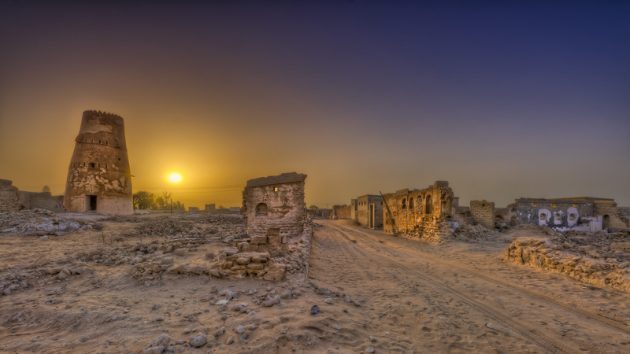
Today, it’s a skeleton. A sprawling ghost town of crumbling coral houses and silent mosques baking under a relentless sun. It’s a wound in the landscape, a place time forgot. But it wasn’t always this way. For centuries, this was a vibrant, bustling community. A jewel of the Arabian Gulf. Then, in 1968, something happened. The people—thousands of them—simply vanished. They walked away from their homes, their businesses, their entire lives, leaving the town to the wind and whatever else lurked in the shadows.
The official story is neat. Tidy. But the whispers that snake through the alleyways of Jazirat al Hamra tell a different tale. A story not of economics or politics, but of something ancient. Something angry. A story of the Jinn.
Before the Silence: A Kingdom Built on Pearls
You have to see it to believe it. Before the oil, before the skyscrapers that punch holes in the sky, the lifeblood of this land was the sea. And from the sea came pearls. Jazirat al Hamra, primarily home to the powerful Za’ab tribe, was the beating heart of this industry. From its founding in the 14th century, it grew into a maritime powerhouse.
Imagine it. Hundreds of wooden dhows dotting the turquoise water. Men, with lungs of steel and incredible courage, diving deep into the crushing dark, holding their breath for minutes at a time, searching for oysters. It was a life of extreme risk for extreme reward. A single, perfect pearl could make a man a king for a year.
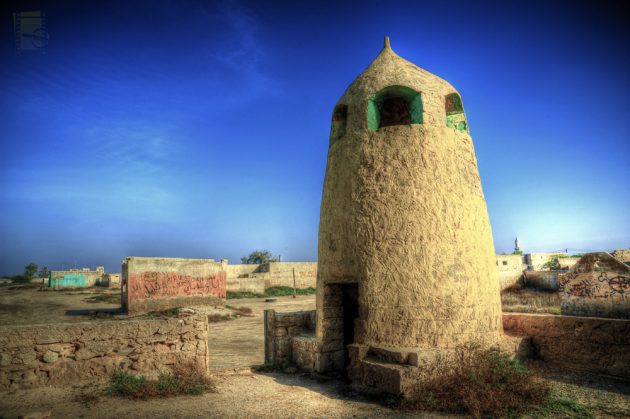
The town itself was a work of art. Not built of modern concrete and steel, but from the very essence of the coast. The walls of the more than 300 houses, the souk, the forts, and the 13 mosques were constructed from coral blocks and fossilized beach rock, bound together with a mortar of mud and seashell. In the golden light of dawn and dusk, the entire village would glow with a soft, reddish hue. The Red Island. The name was literal.
Life was tough, governed by the rhythm of the tides and the pearling seasons. But it was a community. Families lived in the same homes for generations. The air was filled with the sounds of merchants haggling, children playing, and the call to prayer echoing from the minarets. It was alive.
And then, it wasn’t.

1968: The Year the World Went Quiet
Why does an entire town of thousands of people get up and leave? Not over years. Not a gradual decline. But a sudden, mass exodus. This is the question that hangs over Jazirat al Hamra like a shroud. The history books offer explanations, of course. But none of them quite seem to fit the chilling silence of the place.
Theory 1: The Official Story (The One They Want You to Believe)
The most common explanation is a one-two punch of economics and progress. First, the Japanese perfected the art of the cultured pearl in the early 20th century. Suddenly, the world market was flooded with cheaper, perfectly round pearls. The dangerous, unpredictable art of pearl diving in the Gulf couldn’t compete. The town’s primary source of wealth dried up, slowly but surely.
Then came the oil boom. The discovery of black gold in the region, particularly in nearby Abu Dhabi, changed everything. Why risk your life in the sea for a dwindling return when you could get a steady job, a modern house with electricity and running water, and a future for your children just a few hours’ drive away? The people of Jazirat al Hamra, according to this theory, simply moved on. They left their old-world village for the promise of the new world. It makes sense. It’s logical. It’s also, according to some, a convenient cover story.
Theory 2: A Feud of Flesh and Blood
History is rarely clean. It’s often driven by ego and power. A less-discussed but historically documented theory points to a bitter dispute between the Za’ab tribe and the then-ruler of Ras Al Khaimah, Sheikh Saqr bin Mohammed al Qasimi. Tribal politics in the region were—and are—incredibly complex. Disagreements over land, resources, or influence could escalate quickly.
Records suggest that tensions flared, and a point of no return was reached. The Sheikh of the Za’ab tribe, in a move of defiance and pride, is said to have led his entire community away from the land under Sheikh Saqr’s rule. They abandoned their ancestral homes not just for money, but to make a statement. They relocated, many of them to Abu Dhabi, under the protection of a rival Sheikh. This explanation adds a layer of human drama and conflict. It feels more personal. But does it explain the bone-deep terror that people still feel when they walk the village’s dusty streets after dark?
Theory 3: The Unspeakable Truth (The One They Whisper)
Forget politics. Forget economics. The story that has truly kept Jazirat al Hamra embalmed in mystery is far older and far more terrifying. This story says the people didn’t just leave. They fled.
They fled from something that rose from the sea, or the sand, or from the very shadows of their coral homes. They fled from the Jinn. Local lore insists that the town was built on land that belonged to these powerful, elemental beings. For centuries, an uneasy truce existed between the humans and the Unseen. But in 1968, that truce was broken. Something was done—a desecration, an offense—that unleashed their full fury upon the town. The hauntings became so violent, so constant, so malevolent, that to stay meant madness or death. So they left. All of them. In a hurry.
The Ancient Ones: A Deep Dive into the Jinn
To understand the fear surrounding Jazirat al Hamra, you have to understand the Jinn. This isn’t the stuff of cartoons or friendly genies in a lamp. In Arabian and Islamic folklore, Jinn are very, very real.
They are a third race of intelligent beings, created by God alongside humans (made from clay) and angels (made from light). The Jinn? They were forged from “smokeless fire.” They occupy a parallel world, an unseen dimension that overlaps with our own. They have free will. They live, eat, marry, have children, and die. Just like us. And just like us, they can be good, evil, or somewhere in between.
They are powerful shapeshifters, capable of appearing as humans, animals—most commonly snakes or black dogs—or as monstrous apparitions. The most powerful and malevolent among them are known as Ifrits or Marids. They can possess humans, drive people mad, and are fiercely territorial. Deserts, ruins, and coastlines are their favorite haunts. Places just like Jazirat al Hamra.
To offend a Jinn is to invite disaster. It is this deep-seated cultural belief that gives the ghost town its terrifying power. When locals say the village is haunted, they don’t mean the gentle spirits of their ancestors. They mean it is occupied. Colonized by powerful, non-human entities who do not want you there.
Footprints in the Dust: Evidence of the Unseen
For decades, Jazirat al Hamra has been a magnet for thrill-seekers, paranormal investigators, and the just plain curious. The stories they bring back are unnervingly consistent.
The Infamous Handprints
This is the most common report, a chilling calling card of the village’s occupants. Visitors will enter a thick-walled, dusty room that has been sealed for fifty years. And there, on an interior wall, will be a fresh handprint. Sometimes small, like a child’s. Sometimes inexplicably large. Horror filmmaker Faisal Hashmi famously reported this experience, claiming he and his friends found them inside a supposedly locked house, a clear warning to get out. The handprints appear and disappear, a direct and physical violation of our reality.
Voices on the Wind
Stand in the center of the village, especially as the sun begins to set, and listen. At first, you’ll only hear the wind whistling through the empty doorways. But stay longer, and you might hear other things. The sound of a baby crying from a house with no roof. The faint laughter of children echoing down an empty alley. Or most chillingly, harsh whispers in a language you can’t understand, seeming to come from right behind you. Many have fled the town in terror, pursued by disembodied voices that grow louder and more agitated the faster they run.
Creatures of Shadow and Fire
The truly terrifying encounters are visual. People report seeing dark figures darting between buildings at the edge of their vision. Others speak of a tall, spectral woman seen wandering the shoreline, beckoning men towards the water. Goats with burning eyes are a common motif, an animal form often associated with powerful Jinn. There are even stories of a terrifying entity that manifests as a huge, hulking man, half-human and half-beast, that confronts those who venture too deep into the village’s oldest sections. These aren’t just bumps in the night; they are full-blown apparitions that defy all rational explanation.
The Village Today: A Playground for Ghosts and Ghost Hunters
In the age of the internet, Jazirat al Hamra’s legend has only grown. A search on YouTube or TikTok will reveal countless “ghost hunting” videos shot within its crumbling walls. You’ll find grainy footage of floating orbs, recordings of supposed EVPs (Electronic Voice Phenomena) capturing strange whispers, and jump-scare-filled explorations after dark.
While many of these are likely faked for clicks, they speak to a modern fascination with this ancient terror. Internet forums are filled with theories. Some users have analyzed satellite photos, claiming the village’s layout corresponds to ancient occult symbols. Others share stories passed down from their grandparents, former residents who refuse to even speak the town’s name aloud.
Walking through the village today is an eerie experience. The heat is oppressive. The silence is profound. You can see the remnants of life everywhere—a decorated doorway, a niche in a wall where a lamp once sat, the outline of a family’s courtyard. It feels profoundly sad. But as the sun dips lower, that sadness is replaced by a palpable sense of unease. A feeling of being watched. Every gust of wind sounds like a footstep. Every shadow seems to move. You begin to understand why people fled. You begin to want to flee yourself.
Paved Paradise: Can Jazirat al Hamra Survive the Future?
The biggest threat to Jazirat al Hamra today may not be the Jinn, but the bulldozer. The UAE is a nation obsessed with the future. Luxury resorts and sprawling developments are constantly expanding. For years, the village’s haunted reputation was its greatest protection—no one wanted to build on cursed land. But money is a powerful exorcist.
Parts of the village have been cordoned off, and some buildings have been carefully restored for their historical value, intended to be part of a future heritage site. It’s a race against time. Can historians and preservationists save this unique piece of the nation’s soul before it’s either swallowed by the desert or flattened for a new five-star hotel?
Maybe the ghosts of Jazirat al Hamra aren’t Jinn made of smokeless fire. Maybe the real ghost is history itself. The memory of a lost way of life, a community scattered to the winds. A silent testament to a time before oil, when the fortunes of a nation rested on a simple, luminous pearl.
Or maybe not. Perhaps when the last tourist has gone home and the moon rises high over the Red Island, the true residents emerge from the shadows. They watch. And they wait. Waiting for the day the world forgets their story, so they can claim their home, once and for all.