Home Unexplained Mysteries UFO Mysteries Fleet of UFO’s fly by Space Station

Fleet of UFO’s fly by Space Station

0
77

The ISS Ghost Fleet: What Did NASA Try to Hide in 2013?

There it hangs. A marvel of human ingenuity. A silver outpost suspended in the silent, black ocean of space. The International Space Station. Our eye in the sky. It’s our front porch to the cosmos, a symbol of global cooperation, beaming back breathtaking images of our world and the heavens beyond.

But what if it’s also a silent witness?

What if, from its god-like vantage point 250 miles above us, it sees things that we aren’t supposed to see? Things that move in ways they shouldn’t. Things that defy our understanding of physics. Things that are… not ours.

Forget the grainy photos from the 1950s. Forget the desert crash stories. For a moment, look up. Because one of the most chilling and compelling modern UFO events didn’t happen in a remote field. It happened right on NASA’s own doorstep, broadcast for the world to see. Until the feed was cut.

The date was February 28, 2013. And it was the day a ghost fleet sailed past the International Space Station.

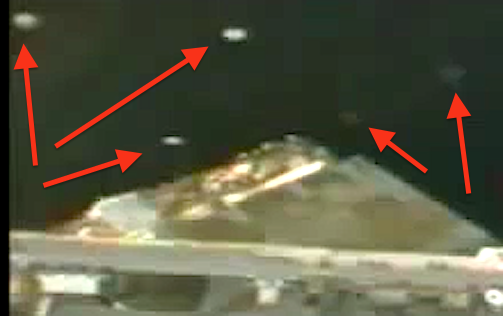
Fleet of UFO's fly by Space Station

A Normal Day in Orbit, Then… This.

For UFO hunters and space watchers, the ISS live feed is a constant source of fascination. Most days, it’s a serene, almost hypnotic stream of the Earth’s curve, the shifting clouds, and the slow dance of the station’s solar arrays. But on that late February day, the view changed.

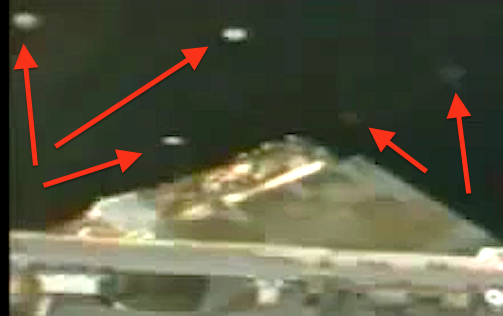
Objects appeared. Not one. Not two. A formation.

They drifted into view, luminous and self-contained against the infinite black. They moved with a purpose that seemed to mock the random, chaotic paths of typical space junk. They held a loose, but definite, formation. Some were brighter, some dimmer. They traveled together, a silent procession of lights moving past our most advanced piece of orbital technology.

Who was watching who?

Online forums lit up. Video recorders captured the moment. The enthusiast community, long accustomed to spotting anomalies, knew this was different. This wasn’t a lone, ambiguous light. This looked organized. It looked like a fleet.

Deep Dive: The Troubling History of the ISS Live Feed

To understand the gravity of the 2013 incident, you have to understand the bizarre history of NASA’s own cameras. Since the live feeds went public, they’ve been a source of endless controversy. Viewers have reported hundreds of anomalies. Strange lights. Fast-moving objects. Geometric shapes appearing and disappearing.

And what happens, almost without fail, when one of these objects lingers on screen for too long? When it performs a maneuver that can’t be easily explained?

The feed cuts.

Suddenly, the screen goes blue. A message appears: “Please stand by. The High Definition Earth Viewing experiment is either switching cameras, or we are experiencing a temporary loss of signal with the International Space Station.”

A temporary loss of signal. Right at that exact moment. Every. Single. Time. It has happened so consistently that it’s become a dark joke in the UAP community. It’s not a technical glitch; it’s a “tell.” It’s the digital equivalent of a security guard quickly pulling a curtain over a window. NASA maintains these are routine signal losses or camera switches. But the timing? The sheer, unbelievable coincidence of it all? It stretches credibility to its breaking point.

This history is the backdrop for the 2013 sighting. The public has been conditioned to expect a cover-up. We’ve been trained by the agency’s own actions to believe that when something real shows up, our view will be the first thing to go.

Analyzing the 2013 Footage: What Are We Looking At?

Let’s break down the actual video. What did those cameras capture before the inevitable blackout? The footage is eerie, raw, and undeniably strange.

The objects glide past with an unnerving grace. This is the core of the mystery. Not just that there are lights, but *how* they behave.

The Case for a Non-Human Fleet

Those who believe this was a genuine UFO event point to a few key factors. First, the formation. Random debris doesn’t fly in a coordinated group. Ice crystals, a common explanation, tumble and disperse chaotically. These objects maintained a relative distance from one another, suggesting some form of controlled flight. Or at least, a common point of origin and trajectory that is hard to explain by natural means.

Second, their appearance. They appear to be self-luminous. They aren’t just reflecting the sun. They glow with their own internal light. Skeptics will have their say, but on the screen, they look like a squadron of powered craft.

Third, the context. This wasn’t a one-off. It’s part of a massive pattern of similar sightings around the ISS. The astronaut Story Musgrave, a man with six spaceflights under his belt, has spoken of seeing an eel-like object in orbit. Dr. Gordon Cooper, one of the original Mercury Seven astronauts, testified to the United Nations that he believed UFOs were real. These are not just random people on the internet; these are the pioneers of space exploration.

Were these objects probes? Alien drones gathering data on our orbital capabilities? Or was it something more? A simple, silent fly-by to let us know we’re not alone?

The Official Explanations (And Why They Fall Short)

Of course, there’s the “official story.” Or rather, the collection of go-to skeptical explanations that get trotted out every time something like this happens. Let’s look at them. Is that what we’re seeing here?

  • Ice Crystals: This is a favorite. Small particles of ice from the station’s vents catch the sunlight and create a glittering, out-of-focus effect. Plausible? Sometimes. But does it explain objects moving in a seemingly coordinated group? The ice crystal theory works well for random, sparkly dispersions, but less so for a parade.
  • Space Debris: There are millions of pieces of junk in orbit, from spent rocket stages to tiny flecks of paint. Could this be a cloud of debris? Possibly. But again, we come back to the formation and the self-luminous quality. Most space debris is small, dark, and tumbles erratically. It doesn’t typically glow and fly in formation.
  • Lens Flare: A classic. A trick of the light inside the camera lens. But lens flares move when the camera moves. They often have a distinctive geometric shape. These objects moved independently of the camera, across the background of space. So, no. Not lens flare.
  • Distant Satellites: Could they be a string of satellites, like Starlink? Not in 2013. The first Starlink satellites weren’t launched until 2019. While it could be other conventional satellites, they are rarely so tightly grouped and visible in this manner.

Each official explanation, when held up to this specific piece of footage, feels inadequate. It feels like trying to explain a thunderstorm by saying someone is just flickering a light switch. The scale is wrong. The explanation doesn’t fit the observation.

What If They’re Not Aliens? The “Solar Warden” Rabbit Hole

So if it’s not space junk, and it’s not aliens from Zeta Reticuli, what’s left? This is where the story takes a turn into an even deeper, darker conspiracy. One that suggests the most advanced technology in our skies doesn’t belong to extraterrestrials. It belongs to us.

Enter the “Secret Space Program.”

It’s a sprawling theory with many names: Solar Warden, the Dark Fleet, the Interplanetary Corporate Conglomerate. The core idea is this: for decades, governments (or a shadowy cabal within them) have been reverse-engineering recovered alien technology or have simply developed propulsion and energy systems far beyond what is publicly known.

The result? A secret fleet of advanced spacecraft that can operate with impunity in our solar system. A breakaway civilization with technology 50, 100, maybe 1,000 years ahead of the public sector. The ISS, in this scenario, is just the public-facing, “vanilla” space program. It’s the old, slow, conventional tech meant to keep us all looking one way while the real action happens somewhere else.

Could the 2013 ISS fleet have been a squadron of our own secret craft? A patrol from Solar Warden flying by the public program’s outpost? It’s a mind-bending thought. It would mean the greatest secret in human history isn’t that aliens exist, but that we’ve already joined them in the stars, and no one told us.

Believers in this theory point to the testimony of whistleblowers like Gary McKinnon, a hacker who broke into NASA and military computers in 2002. McKinnon claimed he found evidence of a secret program, including a spreadsheet with a list of “non-terrestrial officers” and ship logs for craft with names like “USSS LeMay” and “USSS Hillenkoetter.”

Was he a fantasist? Or did he stumble upon the biggest cover-up of all time? When you look at the 2013 footage through that lens, it takes on a whole new meaning. It’s not a first contact. It’s just traffic.

The Silence is the Answer

In the end, what is most damning about the 2013 ISS fleet sighting? It’s the silence. NASA, an agency with a multi-billion dollar budget dedicated to space exploration, an agency that employs some of the smartest people on the planet, has never offered a serious, detailed explanation for this or the hundreds of other UAP incidents captured by its own cameras.

They don’t analyze it. They don’t discuss it. They just cut the feed and pretend it didn’t happen.

This is the same agency that can tell you the chemical composition of a moon 1.8 billion miles away but apparently can’t identify a group of glowing objects right outside its own window. That silence, that refusal to engage, is more suspicious than any blurry photo.

The world is changing. The US government and the Pentagon have finally started to admit that, yes, there are things in our skies and in orbit that we cannot identify. The UAP conversation has moved from the fringe to the halls of Congress. But the 2013 incident remains an uncomfortable ghost, a reminder that we’ve been seeing these things for years, right where we were told they couldn’t possibly be.

So what was it? A fleet of alien explorers? A secret squadron from a human breakaway group? Or just a remarkably persistent cloud of ice crystals that happened to fly in formation?

The footage is there. The questions remain. And somewhere, 250 miles above your head, the ISS continues its silent watch, seeing things that we can only guess at. The feed might cut out, but our curiosity never will.

Originally posted 2016-05-01 00:28:06. Republished by Blog Post Promoter