Monday, August 10, 2026
HomeWeird WorldStrange PlacesFinance’s Bermuda triangle

Finance’s Bermuda triangle

You’ve heard the stories. Planes vanishing into thin air. Ships found drifting with the crew’s coffee still warm on the table. The Bermuda Triangle is a legend that keeps us up at night. But what if I told you there’s a bigger black hole out there?

A much, much bigger one.

It doesn’t swallow Cessnas or fishing trawlers. It swallows money. Trillions of it. This isn’t folklore. This isn’t a campfire ghost story. This is the global financial system.

Welcome to the Bermuda Triangle of Finance.

The Mystery of the Missing Trillions

Let’s get real for a second. We like to think money is solid. You earn it, you spend it, the government taxes it. Simple math, right? Wrong. In the high-stakes game of corporate finance, math is merely a suggestion.

There is a phenomenon happening right under our noses that most people never see. It’s buried in spreadsheets so dense they’d make a mathematician weep. It’s the “Tax Break for Debt.” Sounds boring? That’s what they want you to think. Boredom is the ultimate camouflage.

Here is the hook. Most governments can tell you exactly how much money they lose by giving everyday people a break on their home mortgage interest. That number is public. It’s tracked. But when you ask, “Hey, how much tax revenue are we losing because we let massive global corporations deduct the interest on their massive debts?”

Silence.

The signal goes dead. The radar sweeps, but the screen stays blank.

Why is this second type of tax break—interest deductibility for companies and financial giants—so impossible to track? Why is it harder to find than a needle in a haystack? Because the haystack is infinite, and the needle is made of invisible ink.

The Architecture of the Void

As the financial system has mutated, growing bigger and “fiddlier” (a polite way of saying “purposely confusing”), we’ve lost the plot. Nobody—and I mean nobody—really knows how much interest the world’s firms are paying.

Think about that. In an age of surveillance capitalism where your phone knows what you want for dinner before you do, the global governments have no clue how much cash is bleeding out of the system through corporate debt loopholes.

We look at the National Accounts. Then we look at the figures from publicly listed firms. Then we check the limited tax statistics that actually exist. Do they match? Not even close. They all scream different answers. It’s like three witnesses to a crime giving three totally different descriptions of the getaway car.

Deep Dive: The “Tax Shield” Conspiracy

Let’s break this down. Why does this matter to you?

Corporations have two main ways to get money to grow. They can sell pieces of themselves (equity/stocks), or they can borrow money (debt).

If they sell stock, they pay dividends to shareholders. The government usually taxes those profits before they are paid out. But if they borrow money? The interest they pay on that debt is treated as a “business expense.” It is tax-deductible.

This creates a massive incentive. It encourages companies to load up on debt. It’s cheaper to owe money than to own value. This is the “Tax Shield.” It protects corporate profits from the taxman. But it also creates a system built on a foundation of I.O.U.s.

The mystery isn’t just “how much money is lost.” The mystery is “how unstable have we made the world?”

Hunting the Ghost Data

To try and crack this code, analysts—including the brave souls at The Economist—have tried to reconstruct the scene of the crime. They used national-accounts data. Why? Because theoretically, that should show us everything. The broadest range of activity. The big picture.

But even then, they had to perform forensic accounting surgery to get a clear image.

  • The Adjustment Bureau: They had to lower the estimates manually.
  • Net vs. Gross: For non-financial firms, they only looked at “net” interest.
  • The Bank Job: For financial firms, they included an estimate of interest paid on debt, but—get this—they had to exclude what banks pay on deposits. Why? Because that money is a ghost. It moves differently.
  • The American loophole: In the US, they had to completely cut out partnerships and “pass-through” entities. These are massive organizations that don’t pay corporate tax at all. They just… pass the money through. Invisible.

It’s messy. It’s chaotic. It’s designed to be unreadable.

The Fog of War (Financial War, That Is)

Even with the best minds on the planet crunching the numbers, the uncertainty is staggering. It’s like trying to map the ocean floor with a flashlight.

National accounts use a definition of “financial firm” that is so crude it’s laughable. It’s a bucket that catches everything. It might include a traditional bank. But it also includes the shadowy assets of investment funds. Do those funds pay corporation tax? Maybe. Maybe not. It depends on where they are domiciled. Are they in New York? Or are they in the Cayman Islands?

The data doesn’t say.

Furthermore, the aggregate figures “net” the profits and losses. This is a massive distortion. If Company A makes a billion dollars and Company B loses a billion dollars, the aggregate looks like zero. But Company A owes tax, and Company B doesn’t. When you smash them together in the data, the tax liability vanishes from the record.

And then there are the Zombie Companies. Firms that are losing money. They wouldn’t pay tax anyway, regardless of the regime. But they clutter the data. They add static to the signal.

The Dividend Illusion

Skeptics will say, “But wait! Investors pay tax on dividends!”

Do they? Some do. Many don’t. Pension funds, sovereign wealth funds, and certain accounts are exempt. There is a theory that this exemption might cancel out the bias toward debt. It’s a nice thought. A comforting bedtime story. But we haven’t even tried to capture that effect here because the rabbit hole goes too deep.

Two Terrifying Conclusions

After sifting through the wreckage of the data, two things become crystal clear.

1. We Are Flying Blind.
Governments need to fix their data collection. Immediately. It is frankly terrifying that the entities in charge of the global economy are operating with such a massive blind spot. It’s like driving a Ferrari at 200mph with a bag over your head. You might be fine for a few seconds. But eventually? Crash.

2. The Debt Bomb is Ticking.
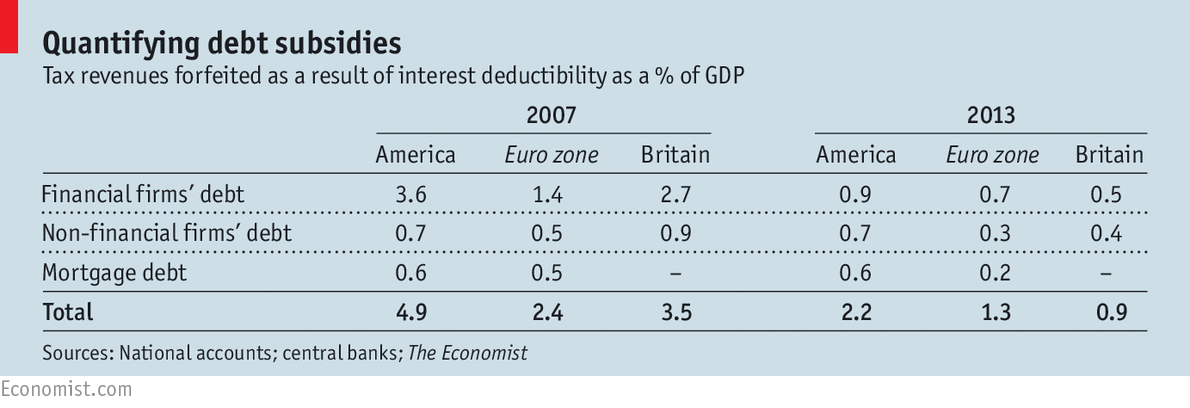
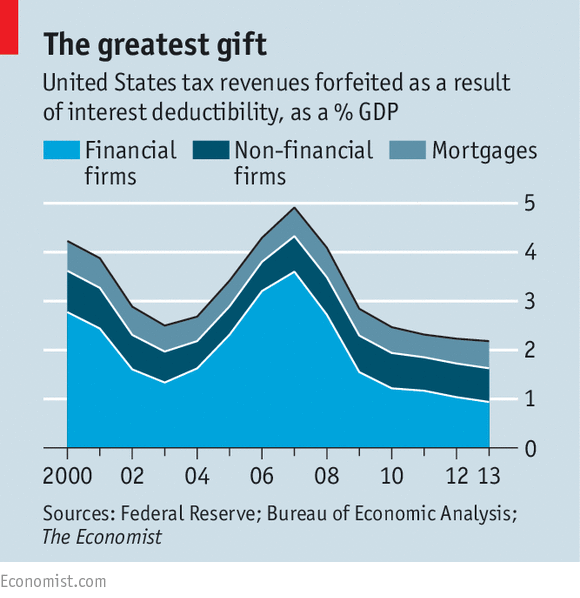
Despite the fog, one fact pierces through: Tax breaks for debt are BIG. Huge. Astronomical. And here is the kicker—they are this big even when interest rates are low.

Think about the last decade. Money was free. Interest rates were near zero. And yet, the tax breaks were still massive.

What happens now?

We are entering an era where interest rates are normalizing. They are rising. The cost of borrowing is going up. If companies are paying more interest, the tax deductions they claim will skyrocket. The amount of revenue lost by governments will “balloon.”

We are talking about levels last seen before the world fell apart in 2008.

The Lehman Echo

Remember Lehman Brothers? Remember the panic? The chaos? The system was over-leveraged. Too much debt. Too little actual money.

This tax structure—this “Bermuda Triangle”—encourages exactly that kind of behavior. It rewards risk. It subsidizes the very thing that causes crashes. By making debt cheaper than equity, the tax code is practically begging corporations to gamble.

So, the next time you hear about a confusing financial regulation or a tax loophole, don’t tune out. Don’t change the channel. That confusion is the weapon.

The money is disappearing. The debt is piling up. And the radar screen is still blank.

Are we heading for another vanish? Only time will tell. But the coordinates are set.

Arindam Mukherjee
Arindam Mukherjee
Arindam loves aliens, mysteries and pursing his interest in the area of hacking as a technical writer at 'Planet wank'. You can catch him at his social profiles anytime.
RELATED ARTICLES
- Advertisment -

Most Popular

Recent Comments

Warren Pan Abbott on The legend of the Devil Monkey !
chris davies on The McPherson Tape Mystery
Reed Reedly on ET has Internet!
Bea Houseoffashion on Proof Of Time Travellers – Gallery
Marcus2012 on ET has Internet!
Reed Reedly on ET has Internet!
LaughsAtConspiracyNuts on The 9/11 Conspiracy – Myths and Facts
Alex Sliverman on Did the ancients fly?
Doctor Wholigan on Time Traveler in 1938 film
chris davies on The McPherson Tape Mystery
Archie1954 on 10 secret UFO hideouts
chris davies on Ghosts of flight 401
Marcus2012 on ET has Internet!
jason Macdonald on Proof of Time Travel? – China
chris davies on Long-Lost Pyramids Found?
Reed Reedly on ET has Internet!
Milkman on Connected Universe
Tenmiles on Baigong Pipes Mystery
Simon Foster on Sirius – The Documentary
From the 1st April on 2013 – Alien Contact date ?
SkyWatcher on Is ET ignoring us?
I Come From The Future on Obama to make UFO Alien disclouser soon ?
Just another person on 2013 – Alien Contact date ?
Malcolm Windowcleaner on The strange case of Rudolph Fentz
Mason Servio on Strange Things on Mars
Marke Wisdom Seeker on What will we find as arctic melts?
Andrea A Elisabeth Levyne on Aliens Captured in Varginha, Brazil
Mitch Grouyeki on Amazing Space Shuttle pictures