The Silent Giants of Laos: Who Built the Mysterious Plain of Jars?
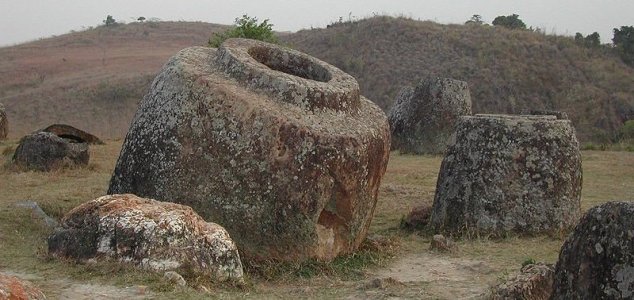
Picture this. You’re standing on a rolling green plateau in the highlands of Laos. The air is thick with the scent of damp earth and a history so old you can almost feel it humming beneath your feet. And all around you, scattered as if by a careless giant, are thousands of colossal stone jars.
Some are short and squat. Others tower over you, three meters tall, weighing several tons. They litter the landscape like massive, stone chess pieces in a game that ended millennia ago.
Who made them?
Why?
And what secrets are they still guarding after all this time?
This is the enigma of the Plain of Jars. It’s one of the most baffling and important prehistoric sites in all of Southeast Asia, a sprawling outdoor museum of megalithic madness. For generations, these silent stone sentinels have fueled wild speculation, local legends, and one very big, persistent question: what on earth were they for?
Whispers From the Stone: A Landscape of Questions
Let’s get one thing straight. It’s not just one plain. The name is a bit of a misnomer. We’re talking about more than 90 distinct sites spread across the rugged Xieng Khouang Plateau. Some sites have a few hundred jars. Others have just a handful. But together, they form a vast, mysterious network.
These aren’t just crude pots. They are feats of ancient engineering. Carved from solid rock—sandstone, granite, conglomerate—they were somehow hewn from quarries miles away and then transported to their final resting places. How? We don’t really know. The people who made them left behind no written language, no grand temples, no named kings. Only the jars.

The jars were built in many different shapes and sizes. Most are cylindrical, but some are square or rectangular. Many have defined lip rims, a sign of sophisticated craftsmanship. Alongside them, archaeologists have found flat stone discs, some decorated with carvings of animals or geometric patterns. Lids, perhaps? Or markers of some kind?
For centuries, the only answers came from myth.
Deep Dive: The Legend of a Giant’s Victory Feast
Ask the locals, and they might tell you the story of Khun Cheung. He was an ancient king, a giant who ruled over the highlands. After fighting a long, arduous war against his enemies, he won a massive victory. To celebrate, he needed an equally massive party. And what does a massive party need? Massive amounts of booze.
According to the legend, Khun Cheung had the jars created to brew and store enormous quantities of potent lao-lao, a local rice wine. The jars were his celebratory cups, and the plains were his party grounds.
It’s a fantastic story. It paints a picture of a mythical past filled with giants and epic celebrations. But archaeologists, as they often do, have a different, perhaps darker, explanation. They believe the jars weren’t for celebrating life, but for honoring the dead.
The Official Story: A Graveyard Unlike Any Other
For a long time, the burial theory was just that—a theory. But recent excavations are finally putting bone to the stone, so to speak. An ancient burial ground containing human remains has been unearthed at a site in Southeast Asia, and the finds are turning history on its head.
Believed to date back up to 2,500 years, the megalithic landscape is now seen by mainstream science as a complex and sprawling mortuary. Surprisingly little is known about the ancient people who built the jars, however researchers generally agree that the stone vessels were associated with prehistoric burial practices.
It wasn’t a simple process. Evidence points to three distinct types of interment:
- Primary Burials: Archaeologists have found skeletons buried in the earth near the jars, laid out whole.
- Secondary Burials: This is the strangest part. Pits have been found containing bundles of human bones. This suggests a multi-stage ritual. The bodies were first left to decompose on a platform or in a tomb somewhere else. After nature had taken its course, the bones were gathered, cleaned, and then ceremonially buried together. Some believe the giant jars themselves were the initial “tombs” where the bodies were left to break down before the bones were removed for final burial. A kind of stone cocoon for a soul’s transformation.
- Miniature Jars: In some pits, tiny clay jars have been found buried with the remains, almost like miniature versions of the huge stone ones. Were these offerings? Symbolic vessels for the afterlife?
Given the craftsmanship exhibited in the construction of the jars and the sheer number of them scattered across the region, the investment in time and resources must have been staggering. This wasn’t a casual undertaking. This was a culture deeply, profoundly invested in how it treated its dead.
Now following a series of recent excavations funded by the Australian Research Council, archaeologists have made a significant discovery in the form of this ancient burial ground. Remains found at the site, including whole bodies and bundles of bones, have so far helped to reveal much about how these ancient people prepared and interred their dead.
Reading the Teeth: A Geographic Passport from the Past
But who *were* they? Were they local farmers? A conquering tribe from afar? To find out, scientists are looking at the one part of the body that holds a map of your childhood: your teeth.
Dr Louise Shewan, a researcher from the Monash Warwick Alliance and Center for Archaeology and Ancient History, has been studying teeth from the bodies in an effort to learn more about them. By analyzing the chemical elements trapped in tooth enamel, she can figure out what kind of water and soil a person was exposed to as a child. It’s like a geological fingerprint.
“My research involves the measurement of strontium isotopes in human dental enamel to shed light on the home environment of the individual,” she said. “Teeth mineralise at different ages, so by analsying different teeth we are able to ascertain where an individual lived during their childhood.”
The early results are fascinating. They show a surprising diversity. It seems the people buried here weren’t all from the same small village. They came from different areas, different geological regions. This wasn’t just a local cemetery. The Plain of Jars was a regional hub, a central gathering place where different communities brought their dead for this special, elaborate burial rite. It was a cultural and spiritual capital for a lost civilization.
Her research is still ongoing, but with any luck, once all the recent finds have been analyzed in detail, it may finally be possible to piece together who these ancient jar builders actually were.
A Deadly Legacy: The Secret War’s Lingering Shadow
So if this place is so important, why has it taken so long to uncover its secrets? The answer is terrifying and tragic.
The Plain of Jars is also the Plain of Bombs.
During the Vietnam War, the United States conducted a “Secret War” in Laos, trying to disrupt North Vietnamese supply lines along the Ho Chi Minh Trail. Between 1964 and 1973, American planes flew over half a million bombing missions over Laos, dropping more than two million tons of ordnance. That’s a planeload of bombs every 8 minutes, 24 hours a day, for 9 years.
It made Laos, per capita, the most heavily bombed country in the history of the world.
A huge number of these were cluster bombs, which released hundreds of smaller “bombies.” Up to 30% of them failed to detonate on impact. They remain in the soil today—unexploded ordnance, or UXO. They are a constant, lethal threat to farmers, children, and, of course, archaeologists.
Many of the most significant jar sites are located in heavily contaminated areas. Every shovelful of dirt could be the last. Research doesn’t just require a brush and a trowel; it requires bomb-disposal experts and nerves of steel. This horrifying modern legacy has dramatically slowed down the process of discovery, wrapping one of history’s greatest mysteries in a layer of very real, modern-day danger. Progress is slow because it has to be.
Fringe Theories & What Ifs: Opening the Rabbit Hole
While the burial theory is the strongest contender, the lack of definitive answers leaves the door wide open for more “out there” ideas. And the internet loves a good rabbit hole.
What if the jars weren’t for burials at all?
One persistent theory, a variation of the giant’s legend, is that they were used for collecting rainwater. The Xieng Khouang Plateau has distinct dry and monsoon seasons. Perhaps the jars were a massive water-collection system for ancient trade caravans passing through the region. But this theory has problems. Why would you go to the monumental effort of carving multi-ton stone jars when a simple cistern would do? And why the elaborate burials right next to them?
Another, more recent internet theory, points to the sky. Could the jar sites be a form of astronomical map? Some amateur researchers have tried to find correlations between the placement of the jar sites and major constellations. Is it possible these ancient people were marking the heavens on the earth below? It’s a compelling idea, but so far, no concrete evidence supports it.
And what if the official dating is wrong? Radiocarbon dating has placed the sites within a specific timeframe, but new technologies could change everything. What if some jars are far, far older, remnants of a civilization that predates anything we know about in the region? A truly lost culture whose only legacy is these baffling stone vessels.
The Future of the Past
Today, the Plain of Jars is a UNESCO World Heritage site, finally getting the global recognition and protection it deserves. This has brought new funding and new technology to the field.
Teams are now using ground-penetrating radar and magnetic surveys to “see” beneath the soil without digging, mapping out potential burial sites and, just as importantly, detecting hidden UXO. Drones equipped with LiDAR are creating hyper-detailed 3D maps of the entire landscape, revealing subtle patterns that are invisible from the ground.
And the most exciting frontier might be DNA. If scientists can successfully extract and sequence ancient DNA from the bone fragments, the story could explode. We could learn about the genetic origins of these people, their family relationships, their health, and maybe even trace their migrations across Asia.
The stones remain silent. For now.
They have kept their secrets for more than two millennia, through the rise and fall of empires, through local legends of giants, and through a brutal modern war that scarred the very land they occupy. They are a profound statement from a forgotten people, a testament to a culture that poured immense effort into how it remembered its dead.
Were they tombs? Wine cups? Rain collectors? An astronomical clock?
Maybe they were all of those things. Or none of them. The only certainty is the jars themselves. They wait, patiently, under the hot Laotian sun, holding the answers within their stony silence.
And we’ve only just begun to listen.
Originally posted 2016-03-30 20:27:50. Republished by Blog Post Promoter