Home Weird World Strange Places Beijing – The Secret Underground City

Beijing – The Secret Underground City

0
70

20140201-011734

The City Beneath the Feet: A Forgotten World

Imagine standing in the middle of Beijing. The noise is overwhelming. Car horns blare. Millions of people rush past you, eyes glued to their smartphones, skyscrapers looming overhead like jagged teeth against the smog. It is the very definition of a modern metropolis. But what if I told you that beneath the soles of your sneakers, there is a second world? A silent, concrete ghost town.

It’s real. It’s massive. And most people don’t even know it exists.

For more than two decades, Beijing’s “Underground City” (Dixia Cheng) has sat quietly in the dark. It is a labyrinth of tunnels, bunkers, and forgotten chambers that mirrors the ancient capital above. While foreigners whisper about it in travel forums and conspiracy threads, the locals have largely scrubbed it from their memory. But why? How do you hide a city capable of holding millions of people?

This isn’t just a basement. This is the “Underground Great Wall.”

The Nuclear Nightmare: Why It Was Built

To understand why anyone would dig a hole this big, you have to transport your mind back to 1969. The world was a powder keg. The Cold War wasn’t just a headline; it was a terrifying reality that kept world leaders awake at night, sweating through their sheets.

We often think of the Cold War as the USA versus the USSR. But in the late 60s, the spotlight shifted East. The relationship between China and the Soviet Union had shattered. They were formerly allies, brothers in ideology, but paranoia had set in. It culminated in the Sino-Soviet border conflict over Zhenbao Island in the Heilongjiang River.

Tanks were rolling. Soldiers were dying. The threat was palpable.

Chairman Mao Zedong was convinced—absolutely certain—that a full-scale nuclear attack from Russia was imminent. He wasn’t taking chances. He issued a command that would change the geology of Beijing forever: “Dig deep, store grain, and prepare for war.”

A Panic-Driven Engineering Marvel

This wasn’t a government contract given to a construction firm. This was a “People’s War.”

20140201-011359

The tunnels were built between 1969 and 1979. But here is the mind-bending part: they didn’t use heavy machinery. There were no massive boring machines or high-tech drills.

It was dug by hand.

More than 300,000 local citizens, including school children, grabbed shovels and picks. They worked in shifts. Day and night. Mud, sweat, and fear fueled the excavation. They moved mountains of earth, bucket by bucket, creating a network that winds for over 30 kilometers (though some theories suggest it is much, much larger) and covers an area of 85 square kilometers.

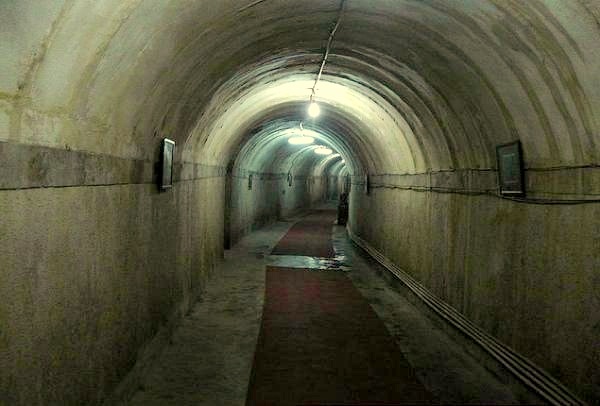
These tunnels sit anywhere from eight to eighteen meters below the surface. That is deep enough to survive a blast, but shallow enough to access quickly. It includes nearly one thousand anti-air raid structures.

The Tragic Cost of Survival

Building a fortress requires stone. A lot of it. And in a time of crisis, you don’t wait for the quarry to deliver. You take what is available.

This is where the story gets heartbreaking for history buffs. To supply construction materials for the complex, the city cannibalized itself. The centuries-old city walls and towers that had circled ancient Beijing for dynasties were torn down. They were smashed into rubble and repurposed as bunker walls.

If you look for the old city gates of Xizhimen, Fuchengmen, or Chongwenmen today, you will find nothing but asphalt and modern signs. They remain in name only. Out of all that ancient glory, only two embrasured watchtowers from Zhengyangmen and Deshengmen survived the panic.

They destroyed their past to secure their future.

A Subterranean Society: Life After the Bomb

The Underground City wasn’t just a hallway to hide in. It was designed to be a fully functioning society. The plan was staggering in its ambition: in the event of an attack, forty percent of the capital’s population would vanish underground. The rest would flee to the neighboring hills.

But once they were down there, what then?

You can’t just sit in the dark waiting for the radiation to clear. You need to live. The complex was equipped with facilities that sound impossibly normal for a bomb shelter. We are talking about stores to buy supplies. Restaurants to eat communal meals. Clinics and full-blown hospitals for the wounded.

Schools, Skates, and Mushrooms?

It gets weirder. They built schools so education wouldn’t stop during the apocalypse. They built theaters and reading rooms for entertainment. Factories were set up to keep production lines moving.

There was even a roller skating rink.

Yes, you read that correctly. While the world burned above, the plan was for children to be roller skating below.

They also needed food. You can’t rely on canned goods forever. The solution? Mushroom cultivation farms. The tunnels were dark, damp, and cool—the perfect environment for fungi. It was a grim form of sustainable farming, designed to keep a population alive on foods that required zero sunlight. There were also grain and oil warehouses, stockpiled to last for months, perhaps years.

Rumors persist that almost every residence in the central districts once had a secret trapdoor. Imagine pulling back a rug in your living room and dropping into a concrete chute that slides you directly into a government bunker. It sounds like spy fiction, but for the people of 1970s Beijing, it was the architectural standard.

20140201-011914There is no authoritative information on how far the mostly hand-dug tunnels stretch, but they supposedly link all areas of central Beijing, from Xidan and Xuanwumen to Qianmen and Chongwen districts, to as far as the Western Hills.

The Modern Mystery: Who Lives There Now?

The nuclear war never happened. Mao passed away. China opened up to the world. The tunnels sat empty, damp, and silent.

So, what happens to a city-sized basement when the tenants don’t move in?

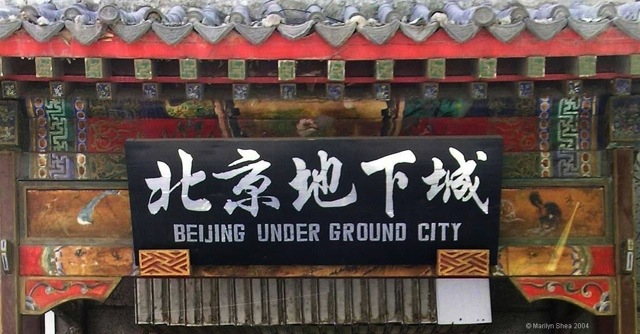
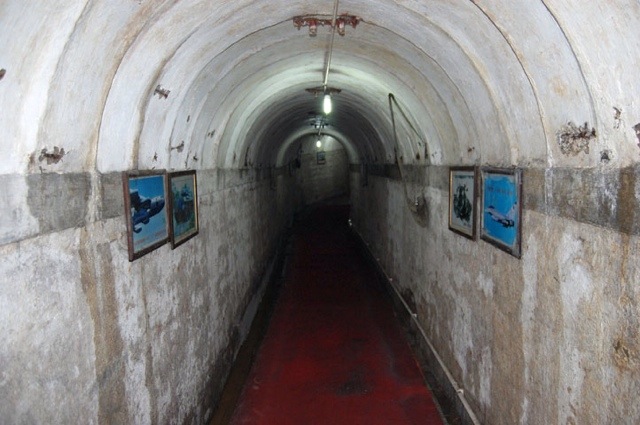
For a while, it became a tourist curiosity. In the early 2000s, foreigners could pay a fee to enter a sanitized section in the Qianmen district. They would walk past old propaganda posters and dusty silk factories that had set up shop in the gloom. But that was just the tip of the iceberg.

In recent years, the story has taken a darker turn. The “Rat Tribe” (Shuzu).

With Beijing’s rent prices sky-rocketing, thousands of migrant workers and students couldn’t afford apartments above ground. So, they went down. While not always in the “official” deep bunkers, many inhabited the reinforced basements and air-raid networks connected to the main system. A subterranean population living in windowless concrete cells, bustling beneath the luxury malls of the capital.

Authorities have cracked down on this in the last decade, citing safety hazards. They evicted the dwellers and sealed the doors. But urban explorers still tell tales of finding active electricity, warm kettles, and sleeping bags in sectors that are supposed to be closed.

The Conspiracy: What Are They Hiding?

Here is the question that keeps alternative history researchers up at night: Why is it so hard to see the map?

Despite having thousands of entrances, foreign visitors usually see only a tiny, approved sliver accessed via a small shop front in Qianmen, south of Tiananmen. And even that has been frequently “closed for renovation” in recent years.

Why the secrecy?

Some theories suggest the network is still fully active for military purposes. If the tunnels really do stretch to the Western Hills (a strategic military command area), they could be used to transport troops or leadership without a single satellite spotting them.

Others believe the tunnels have been expanded, modernized with fiber optics and high-speed rail links that the public isn’t allowed to know about. Is there a connection to the extensive Beijing Subway system? Are there “ghost stations” that don’t appear on any commuter map?

The remaining parts of the underground city remain a tight kept secret!
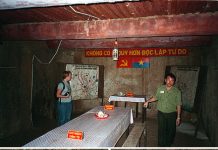
It stands as a silent monument to fear. A concrete time capsule of a war that never came, waiting in the darkness for a future we hope never arrives.

Originally posted 2014-02-01 00:21:48. Republished by Blog Post Promoter

Originally posted 2014-02-01 00:21:48. Republished by Blog Post Promoter